
Geek Lands: technology

A fresh blog on latest technology and programming trends for the Geeks by a Geek.

Recent Posts

Showing posts with label technology. Show all posts

Monday, August 14, 2017

The 25 fastest gaming laptops of 2017

August 14, 2017 0
The 25 fastest gaming laptops of 2017

These are the gaming laptops with the best 3D performance over the past year.


gaminglaptops-02

Gaming on a laptop is no longer the frustrating compromise as it once was due to hardware limitation in small form factor and performance bottleneck due to overheating of components. Slimmer designs paired with more powerful processors and graphics cards have brought gaming laptops closer than ever to performance previously found only in desktops.
And the pace of innovation hasn't slowed down. Just in the past year, thanks to Nvidia GTX lineup have enabled laptops to now easily support high-end virtual reality headsets like the Oculus Rift and HTC Vive, and new designs can fit top-tier graphics hardware into very slim laptop bodies, as in the case of the 17mm thick Asus Zephyrus, which is the thinnest laptop with an Nvidia GeForce 1080 GPU. With AMD bringing in Vega lineup we would hope to see more intense competition between the Red and Green team with some pricing drops making these hardware much more affordable.

Putting gaming laptops to the test

For this roundup, we've taken all the laptops with discrete graphics hardware collected the test scores over the past 12 months, and ranked them based on 3D performance. When testing a gaming laptop or desktop, it was run preset tests using several games, including Deus Ex: Mankind Divided, Bioshock Infinite, and others, along with standard benchmarks like 3DMark, which is designed to test a computer's 3D graphic rendering capabilities.
For this list, we're ranking the laptops in order of 3DMark scores, but the real-world game scores (presented as the number of frames of animation per second the laptop can render) match very closely. Note that these scores are specifically for the exact configurations of each laptop we tested, and almost all can be configured with a wide range of options.
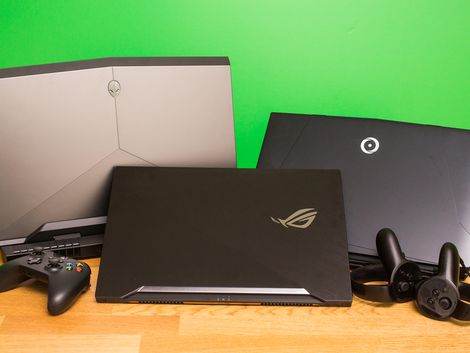


The winners are...

The results offer few surprises. The handful of laptops with dual video cards (rare in a laptop) came out on top, followed by laptops with a single Nvidia 1080 GPU and so on down the list. The No. 1 spot is held by the most expensive laptop we've ever reviewed, the $9,000 Acer Predator 21 X. But at more reasonable prices, systems from Asus, Alienware, Origin PC, Lenovo, HP, MSI and Razer, among others, are all represented.
As we test many more everyday laptops than gaming ones, the last few spots get us into crossover territory, with Nvidia and AMD GPUs that aren't really for gaming, so serious gamers should stick with something that has at least an Nvidia 1050 graphics card.


Top 25 Gaming Laptop Performers


System Name3DMark Fire Strike Ultra scoreGraphicsCard
1Acer Predator 21X9444(2) Nvidia GeForce GTX 1080
2MSI GT838594(2) Nvidia GeForce GTX 1080
3Asus ROG G701V5226Nvidia GeForce GTX 1080
4Alienware 17 R45024Nvidia GTX GeForce GTX 1080
5Origin PC Eon17-X (2017)4970Nvidia GeForce GTX 1080
6Origin PC Eon17-X (2016)4919Nvidia GeForce GTX 1080
7Razer Blade Pro4456Nvidia GeForce GTX 1080
8Asus ROG G752VS-XS74K4126Nvidia GeForce GTX 1070
9Asus ROG Zephyrus4095NVIDIA GeForce GTX 1080 with Max-Q Design
10Alienware 15 R44054Nvidia GeForce GTX 1070
11HP Omen (17-inch)3816Nvidia Geforce GTX 1070
12Origin PC Evo 15-S2671Nvidia Geforce GTX 1060
13MSI GS73VR-7RF Stealth Pro2647Nvidia GeForce GTX 1060
14Alienware 13 R3 (OLED late 2016)2609Nvidia Geforce GTX 1060
15Razer Blade2593Nvidia GeForce GTX 1060
16Lenovo Legion Y7202523Nvidia GeForce GTX 1060
17Dell Inspiron 15 7000 Gaming1871Nvidia GeForce GTX 1050Ti
18Origin PC EON15-S1861Nvidia GeForce GTX 1050Ti
19Lenovo Legion Y5201855Nvidia GeForce GTX 1050 Ti
20Asus ROG Strix GL753VE-DS741822Nvidia GeForce GTX 1050Ti
21Acer Aspire VX 15 -591G1252Nvidia GeForce GTX 1050
22Dell XPS 15 (2017)1242Nvidia GeForce GTX 1050
23Wacom MobileStudio Pro 16810Nvidia Quadro M100M
24Samsung NoteBook 9 Pro547AMD Radeon 540 Graphics
25HP Spectre x360357Nvidia GeForce 940MX


Tuesday, August 1, 2017

9 Books To Boost Your Understanding of Technology & Systems

August 01, 2017 0
9 Books To Boost Your Understanding of Technology & Systems

9 Books To Boost Your Understanding of Technology & Systems


We’re hearing of Mark Zuckerberg’s possible interest in running for president. We refer to Elon by his first name. Bill Gates is the richest man in the world. And every college kid dreams of becoming a tech billionaire. There’s a certain ‘hollywoodization’ of entrepreneurship. Nowadays it’s also much easier to start a business. Throw up a website using one of the many templates out there, host it on Amazon Web Services or GoDaddy, find a pain you think exists and go about trying to solve it. In some cases, folk even try to raise money before the idea is fully fleshed out. It feels that easy. What this has led to is a false narrative about the required level of understanding of what you need to build business.
It’s the easiest time in the world to start a business but it’s also never been harder to build one.
I hear this gap in foundational understanding of business and technology in the many conversations I have with founders. While I recommend that actually doing the work of starting a business and screwing it up is the best way to learn, I also share the story of ‘the Elephant and the blind men
a group of blind men all touch an elephant to learn what it is like. Each one touches a different part and consequently think it is something other than an elephant.
and share the lesson that one cannot tell the whole from the parts; because you think you see a small part of a problem in an industry does not mean you understand how to solve the problem. Most entrepreneurs jump into solving a problem without truly understanding the whole picture or the ‘why’ of the problem.
To help these founders along, I recommend some books that provide a systems understanding of technology. Here are 9 books that’ll ramp you up quickly so that, when you do step out there to start your business, you understand the trends you’re riding, what part of the business cycle you’re in and what foundational systems/models you’re going up against.
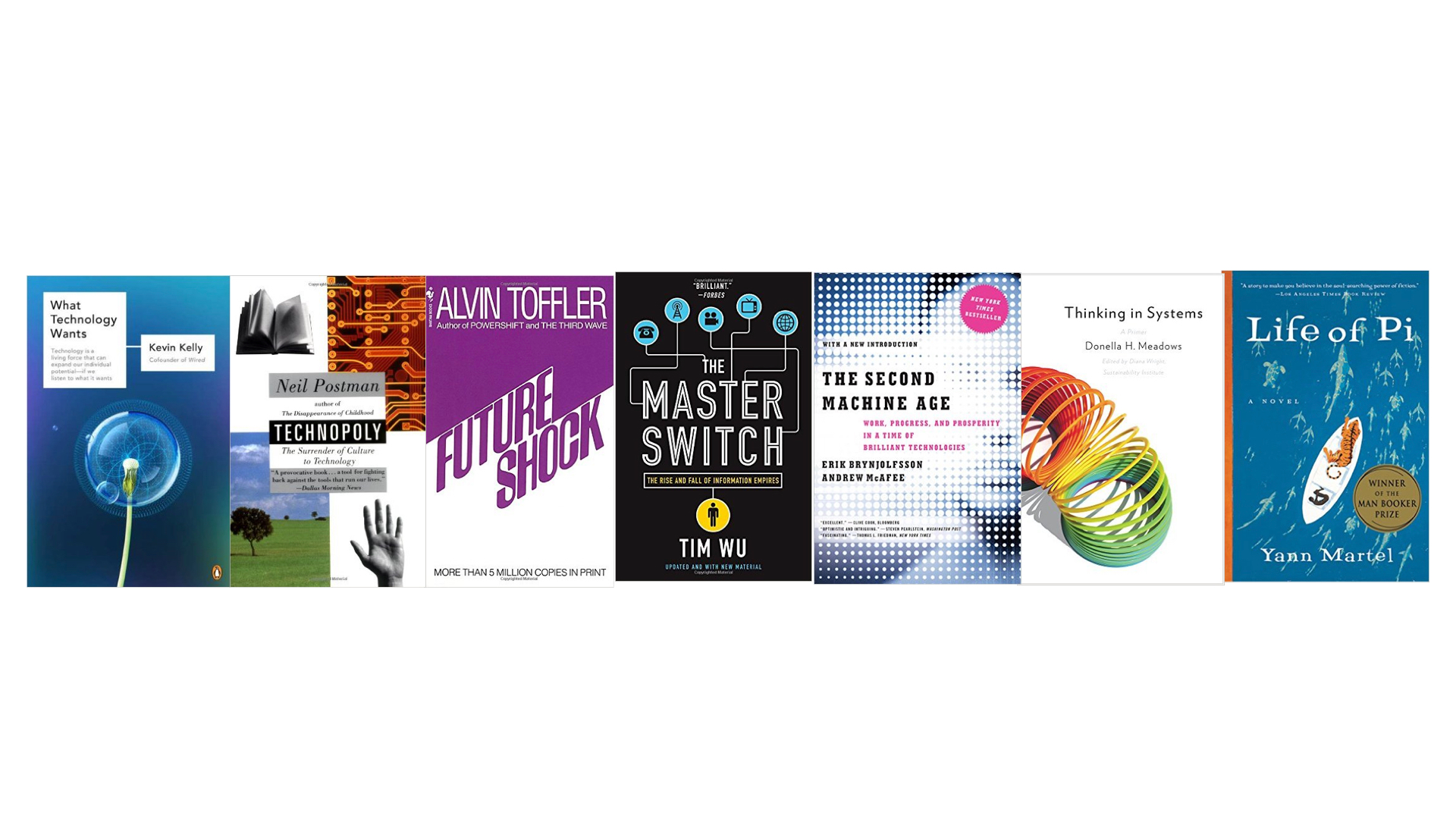
  1. What Technology Wants by Kevin Kelly. A good friend and fellow utility tech enthusiast friend (Eugene Granovsky) clued me into this book. Kevin Kelly would be considered the opposite of Neil Postman (below), as he is one of the foremost proponents of the value we can gain from the technological changes that are inevitable in our lives. He share more of these expectations he has of the technological systems changes around us in his newest book ‘The Inevitable. We’re already seeing the HOLOS = Tech/The Machine + 7 Billion Souls, a force he expounds upon, at play around us.
  2. Thinking In Systems: A Primer by Donella Meadow. The story of the elephant and the blind me above is also included in this, a personal favorite, book in explaining the need to understand systems as a whole. A holistic understanding of systems and the models that operate within these systems at all times is necessary before any disruption can happen. As I like to say, and unfortunately I cannot remember where or from whom I first heard this quote ‘to disrupt a thing, you have to truly understand it’.
  3. The Second Machine Age by Erik Brynjolfsson, Andrew McAfee: The current backlash against Artificial Intelligence and Robots etc. is nothing new. This book focuses on the impact of exponential and combinatorial technological change on human work. Read this as much for the message (we need to proactively do something to push back the worsening conditions of income disparity brought on by technology) as for the study of the systems that are impacted by game changing technological advances like AI and Machine Learning.
  4. The Master Switch by Tim Wu: I’m a big Tim Wu fan. In this book, he discusses the impact of technology (and the information flow that our technology makes possible) on the TV, movie and internet industries. The book is as much a journey through the life of these industries as it is a description of the cycles that technology goes through as they become ubiquitous; all useful technology is innovative until it becomes commonplace. Pair the book with his new one ‘The Attention Merchants’ to learn more about how we got to this point in the life of the internet.
  5. Future Shock by Alvin Toffler: I am currently reading this book again and amongst the many quotes that one can pull from this prescient book, one that speaks to the now of communication technology is ‘…but in almost every other communications medium we can trace a decreasing reliance on mass audiences. Everywhere the ‘market segmentation, process is at work’. Another one that is closely related to the premise of The Second Machine Age (above) in the age of AI is ‘there are discoverable limits to the amount of change that the human can absorb, and that by endlessly accelerating change without first determining these limits, we may submit masses of (hu)mans to demands they simply cannot tolerate’. While some of his context might be outdated, the book was written in 1970, the overarching musings (the accelerating pace of change and of information overload) still hold true today. Probably more so.
  6. Technopoly by Neil Postman: The copy of this book I read is actually my wife’s copy from her undergraduate degree days. Apparently, in her major at Stanford, she had to read this and share her views on the perspectives provided by Neil Postman in this book that is very relevant to the current landscape of technology. It’s the most marked book I’ve ever read (she’s studious like that) but that element of it, someone else’s notes, makes it a fantastic read of a great book that focuses on the inequalities that technology brings to society.
  7. The Life of Pi by Yann Martel: This might seem like an odd one to include on here until you read why. I was having a conversation with Jeremy Adelman about this blog post and... you know what, I’ll let him explain more eloquently than I could why this book helps you understand technology (hint: because it helps us understand our biases and we all know our biases seep into the products we build); “few books force you to confront who you are and your perception of situations and trends. We all have filters and lenses through which we perceive the world and our interpretation of our present and future is wholly through these lenses. This is a critical realization if you want to look at technology trends and build a product that is both on trend and lasting in its ability to solve human pains. Life Of Pi truly makes us think about these lenses and biases.
Which books would you add to the list? Let me know in the comments.